Showing posts with label SEO training courses. Show all posts

3 logical myths that can destroy a business

Columnist Dave Davies breaks down three SEO myths that even rational people believe.

Even the most intelligent people can make decisions based on incorrect assumptions. 



Myth #1: All organic traffic is created equal

This premise has crossed my Inbox more times than I care to recollect. Here’s the core myth:
If we double our organic traffic over the next year, we will double our sales.
Now, this can be true — in fact, in some cases, doubling your organic traffic can more than double your sales. But one can’t approach SEO with this idea as a core.
Let’s take the prospective client, for example. They have site structure issues and a large documentation area and blog. The logic is that if you fix the site structure and internal link issues, you’ll start driving more traffic to the documentation and the blog, which is filled with great content. The problem, of course, is that this traffic is likely to be lower-converting traffic, so hitting the organic traffic targets can be done without hitting what really matters: conversions.
To avoid myth one, the simple approach is to think about the various sections of your site, put a value on those different sections, and then create a formula to ensure that as you’re building out the strategy for the various sections of your site, you’re taking into account the value of that traffic.
Let’s create a simple formula based on the case above. We have a site with product and service pages, a blog and technical documentation. Let’s assume that organic traffic landing in these sections does the following:
  • Site and product pages (represented by x below) — 6 percent conversion rate
  • Blog (represented by y below) — 1 percent conversion rate
  • Documentation (represented by z below) — 2 percent conversion rate
So, our formula for traffic entering the site at various points, assuming a $100 conversion value, would be:
$100 x (0.06x + 0.01y + 0.02z) = revenue
Let’s assume we have $600 in revenue today; that could be attained via 600 visitors entering at the blog:
$100  x (0.06 x 0 + 0.01 x 600 + 0.02 x 0) = $600
Or 100 visitors on the product pages:
$100 x (0.06 x 100 + 0.01 x 0 + 0.02 x 0) = $600
Or 300 visitors to the technical documentation:
$100 x (0.06 x 0 + 0.01 x 0 + 0.02 x 300) = $600
It could also be attained with 50 visitors to the product pages, combined with 146 to the blog and 77 to the documentation. You get the idea.
$100 x (0.06 x 50 + 0.01 x 146 + 0.02 x 77) = $600
So, if we want to double our revenue, we can’t simply double the traffic. Let’s look at the last example. We have:
  • 50 visitors to the product pages
  • 146 visitors to the blog
  • 77 visitors to the documentation
This gives us a total of 273 visitors. If we double our traffic, but the additional 273 visitors are all entering at the blog, we end up with:
  • 50 visitors to the product pages
  • 439  visitors to the blog
  • 77  visitors to the documentation
Enter that into the formula and you get:
100 x (0.06 x 50 + 0.01 x 439 + 0.02 x 77) = revenue
Which works down to :
100 x (3 + 4.39 + 1.54) = revenue
Which gives us a total revenue of $893. So, we doubled traffic but only added about 35 percent to the bottom line — not anywhere near our goals.
The lesson? Not all organic traffic is created equal, but there’s a simple way to figure out what the strategies you are deploying are likely to yield so you can adjust and focus according to your business goals, not arbitrary traffic goals.

Myth #2: It’s important to outrank your competitors

I can’t even count the number of times that I’ve been contacted by both clients and prospects with the statement, “Company XYZ is above me. We’re better than them, and we need to outrank them.”
OK… let’s take a beat and wrap our heads around what’s really being said here. While the statement seems logical, what is actually being said is:
Company XYZ is above me for the phrase I looked up. We’re better than them, and we need to divert all energies away from pursuing ROI goals and focus on one single vanity phrase.
What we need to remember is that none of this is actually about ranking for a specific phrase. In fact, the goal of our efforts is not rankings at all, but rather revenue. I don’t know about you, but if there were higher revenue from ranking in position 21 than position 1, I’d be working hard to get all our clients to the top of page three.
To aid in this, it can be helpful to not just look at keyword volumes using a tool like Moz’s Keyword Explorer (which puts the numbers in more realistic terms for organic search than Google’s Keyword Planner), but to use a tool like SpyFu to get a real picture for how a site is doing overall.
Let’s look, for example, at a phrase I was researching just yesterday, “best cpu 2017.” (Spoiler alert: I’m upgrading my machine.) Now, I immediately went to the #2 organic search result because it’s Tom’s Hardware, and I like the info (admittedly bypassing the featured snippet, which is also Tom’s, because I knew I wanted to read about the different options and applications).
Let’s say, however, that one of their team gets a bee in their bonnet about not ranking #1 in organic for the phrase and getting beaten by Futuremark.com. What if they divert energies from creating new, rankable content, or working on phrases they don’t rank for at all, to pushing up for this one phrase because it’s the only one they’ve looked up and fixated on?
This is where a tool like SpyFu comes in handy. Looking at FutureMark, we can get a decent feel for their rankings and traffic with:
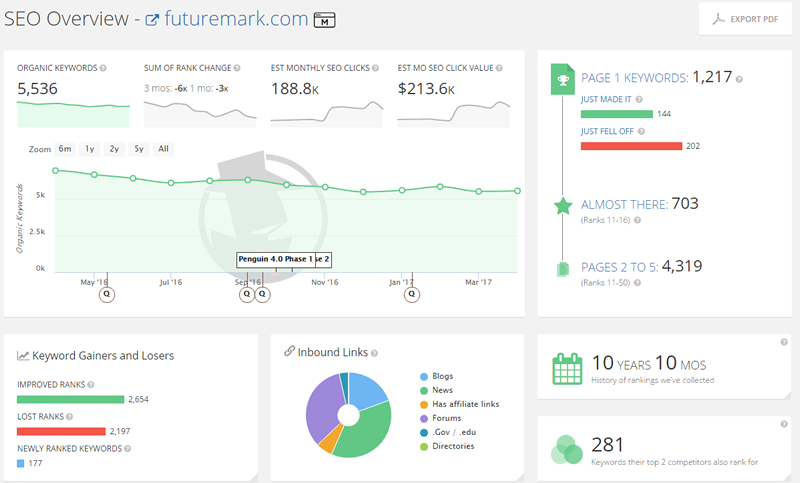
Spyfu competitorSpyfu site
Now, let’s look at Tom’s:
Spyfu site
If I were Tom, I’d be looking more at ranking for new phrases and perhaps researching the types of phrases that are losing ground than I ever would about focusing energies at a single position jump against a competitor ranking for a fraction of the terms. And this is just an example of the scenario I’m referring to. In other situations, people may focus out of the gate on a single vanity term as opposed to a more diversified (read: natural) spread of terms. If nothing else it can be helpful to remember the following:
Diversity is security.
All else being equal, it is better to have 100 phrases each driving 10 visitors than one phrase driving 1,000. As algorithms ebb and flow, you will be impacted less by the whims of Google. Don’t fixate on your rank compared to your competitors for one phrase — make sure you’re making the right keyword decisions to maximize your ROI and resources.

Myth #3: Keyword tools are accurate

Bringing people into reality is often a sad but necessary task. A lot of potential clients include with their initial emails the incredible search volumes for the phrases they’re thinking about.
Let’s flash back a few paragraphs to the part where I mentioned using Moz’s Keyword Explorer as opposed to Google’s Keyword Planner. Why is the former more realistic? It’s because Keyword Planner is built for AdWords traffic and generally produces numbers far above the number of unique searchers that would reach a result via organic. The Moz tool takes this into account and algorithmically (though not perfectly) adjusts for that to give numbers closer to organic reality.
For example, the term “cpu” is given an estimated volume of 74,000/mth using the Keyword Planner. Per the Moz tool, we’d see it ranging from between 30,000 and 70,000. Still a big number, but not the same — in fact, if we averaged the Moz numbers, the estimate would be 50,000/month, or around 33 percent less.
Now let’s make the scenario even worse (read: realistic). You might rank #1 at some point for your phrase, but it’s going to be a process. Let’s be optimistic, however, and assume that a year from now you’re ranking #3 and hold that ranking for the following 365 days. Instead of dreaming that every single person who runs that search (all 50,000/mth) are going to get to your site, let’s assume some click-through rate averages. Here’s what a WordStream study found for traffic by organic position:
CTR impact on rankings in organic search.
So we can see here that, in the number three position in organic search, we were sitting at about 12.5 percent CTR. That’s 6,250 visitors to your site. This is very, very different from the 74,000 expected when the email was sent.
Not understanding what’s realistic in regard to the traffic to be gained from a specific phrase when it’s ranking can lead to critical bad decisions. If you feel you are going to get 74,000 visitors per month for a phrase you’d actually get 6,250 for, your ROI calculations will be off — and you’d likely focus far more energy and resources into it than it warrants. Understanding the true value of a term or group of terms is paramount to understanding how much attention to put into keyword groups and whether they’re truly worth targeting at all.

Conclusion

A lot of mistakes get made before campaigns even begin, and most of them start with a lack of understanding of how keywords and rankings function. No matter how successful the SEO campaign is in regard to the rankings attained, if the principles and data that the efforts were based on are incorrect or misunderstood, then the results can be as catastrophic as if the campaign had simply failed.
Following one guiding principle is all it takes to really avoid the biggest issues: understand what you want, and understand a path to that. Wanting more traffic in itself is not a goal; wanting more conversions and revenue is. Focus on that, and when you’re communicating about strategy, make sure that the discussion is on these business goals and not an abstract idea that, if misinterpreted, could yield actions and efforts that don’t actually support the business but do technically meet the directives given.

From fundamental concerns to sophisticated problems

Whether you're an experienced SEO or somebody that runs your personal company, you recognize there are changes in your natural web traffic, however you might have a hard time to determine the origin. Organic search, unlike its paid equivalent, features an one-of-a-kind collection of difficulties in detecting a decrease in web traffic as well as conversions.

There are some noticeable states you could extract for understandings (Google Analytics, Google Search Console), yet various other variables at play could be faster to measure. From fundamental concerns to innovative concerns to variables that are greatly from your control, adhering to is a checklist of points to look for when identifying significant changes in natural web traffic or online search engine positions. By analyzing both inner and also outside variables, you could begin to assemble the challenge.

 Fundamental concerns 1.

Your web pages typically aren't indexed Conduct a fast Google search making use of "website: yourwebsite.com" making certain your web pages are in fact indexed. If you're discovering that essential web pages typically aren't showing up in the SERPs, you've most likely located the perpetrator. Examine your robots.txt data making certain you have not obstructed vital web pages or directory sites.

If that looks excellent, inspect specific web pages for a noindex tag. 2. Crawler filters Are you presently leaving out all recognized crawlers as well as crawlers in Google Analytics?

Otherwise, you could be experiencing filled with air web traffic metrics and also not also recognize it. Commonly, crawlers get in with the web page and also cascade throughout your website navigating, simulating genuine individual habits. One dead giveaway of crawler website traffic is an extremely trafficked web page with a high bounce price, reduced conversions and also a reduced ordinary time on web page.


 While it's ideal to develop a customized measurement for removing robots, using the common crawler filter is an excellent area to begin. It's vital to keep in mind that filters could not be used retroactively, so if you've just recently switched on this attribute, you ought to be getting much less web traffic.

 In addition, double-check that you are straining your very own web traffic and also IP address. 3. Current website updates If you've lately customized your on-page duplicate, undertook a website overhaul (getting rid of web pages, reordering the navigating) or moved your website sans reroutes, it's affordable to anticipate a decrease in website traffic. After revamping your website material, Google should re-crawl then re-index these web pages. It's not unusual to experience unsteady positions for around a couple of weeks later on.

 If you've transformed your URL framework or gotten rid of web pages from your website, it's essential to have a 301-redirect method in position to protect web link equity and also prevent a loss of rankings/traffic.


4. LINK complication Do you have a material approach in position, or are your initiatives a lot more "off the cuff?" Not having actually a plainly specified keyword map could lead to problem-- specifically if 2 or even more web pages are enhanced for the very same key words. In technique, this will certainly trigger web pages to contend versus each various other in the SERPs, possibly decreasing the positions of these web pages.


Right here is an instance of just what this may appear like: LINK 1: www.mysite.com/cakes/raspberry-chocolate-cake LINK 2: www.mysite.com/flavors/chocolate-raspberry-cake Thankfully, if you have accessibility to a keyword monitoring device, you must have the ability to see a day-by-day break down which URLs Google prefers to place for that specific key words. With a little effort and time, you ought to have the ability to fix the scenario. Advanced concerns 5. Structured information markup Applying organized information markup (such as that from schema.org) may feel like a single job, yet that "established it and also neglect it" attitude could land you in warm water. You ought to be keeping track of the look of your abundant bits often to guarantee they are drawing in the proper info.


As you transform the material on your internet site, this could modify the markup without caution. Similarly, relying on your back-end retailing configuration, items can be set off to demonstrate to "unavailable" schema if one shade variant heads out of stock. As you could envision, this could ruin your click-through prices and also lead customers to buy from your resellers-- or even worse, your rivals! 6.


Advertising tempo & the "Sale Hangover Effect" Did you run a huge promo in 2014, such as an example or flash sale? Did it accompany the very same week this year? Otherwise, your year-on-year contrast will certainly be manipulated. If so, were your previous promos just as luring? Did your brand name launch a brand-new product or deal limited-time items? These aspects alone are hard to determine, as well as we're not also representing Public Relations initiatives, which will certainly likewise influence your natural metrics. There is likewise substantial proof to recommend that the "Sale Hangover Effect" is not simply a sensation. It takes care of 2 variables: share of mind as well as share of purse. Tim Kilroy, founder of AdChemix, describes this irregularity:


Customers just have a lot focus therefore much cash-- as well as for each and every, they established a "budget plan" for just how much they wish to invest with the brand names that are very important to them. Customers spend their interest and also cash right into huge promos. Generally, large coupons have huge outcomes for the merchant, yet the other side is that the promotion has actually cleared the customers' allocate focus and also cash. If the promotion allows sufficient, it also lures some customers to spend too much a bit (or a whole lot). When customers have actually exhausted or surpassed their spending plan, they have the tendency to involve with your brand name much less.


They come to be unsusceptible to marketing messages and also invest less bucks. 7. Rate factor & item deepness As a smart electronic marketing professional, you've undoubtedly toenailed the 4 Ps: rate, item, promo as well as state. Nonetheless, a tactical approach implies absolutely nothing without the 5th P: individuals. Right here is a typical story that numerous e-tailers could associate with: You recognized your "pleasant place" in the market as well as recognize that billing over this limit causes value level of sensitivity. Your core items drive quantity-- which enables you to accomplish fantastic development. After that, someday, your emphasis changed. Possibly you quit creating versions of your ideal vendors, or perhaps you attempted to concentrate on your higher-revenue items-- all the while pushing away individuals that liked your previous offerings. This promptly becomes a "chicken-and-egg" scenario. Are less individuals concerning your website because of inadequate presence in the SERPs?

Or have you changed your item emphasis, as well as is that why customers are no more curious about your brand name? For a fast check, take a look at Google Search Console information, as well as draw placements as well as clicks by web page. If placement is remaining fairly stagnant, this suggests your brand name is not shedding presence in the SERPs, and also there could be a larger problem at play. Unmanageable variables 8. Being outed perform by resellers & associates For optimal direct exposure, you might have introduced an associate program or have numerous resellers under your belt. This is normally a non-issue-- till, certainly, your resellers begin to outrank you for well-known keyword phrases. While this may not hinder your profits objectives, it's a sure thing you're shedding web traffic to these websites. 9. New Google advertisement positioning With Google exterminating right-hand rail advertisements, lots of brand names could be seeing even more of their straight website traffic being cannibalized by paid search advertisements. It will certainly be a long time prior to we're able to measure the complete impact, yet you must bear in mind this. 10.

Market patterns & winding down brand name passion With the exemption of petroleum as well as Picassos, few sectors are "recession-proof" and also experience an inelastic item need. Take a look at just how your rivals are making out, as well as see if they're experiencing the very same issues. While you must take Google Trends information with a grain of salt, considering the larger image might assist give some quality. I would certainly recommend taking this an action additionally by carrying out fads study as well as reading sector records. Brands hold a riches of consumer details that might commonly not appear appropriate to SEO-- as well as sometimes, it's not. Nonetheless, if you're collaborating with an SEO company, often discussing this understanding could supply the missing out on item to the challenge. Recognizing something as easy as "Consumer inclinations are changing around the shade black" might assist clarify why your web traffic is down if your items are commonly coupled with black footwears. Often it's as very easy as linking the dots.

Social media projects are a ...


Social media projects are a powerful tool for engaging with customers. When building a solid social media visibility, numerous elements play an important function. Initially, you will require to research which platforms are available and choose which network you will keep. Each social media network has its neighborhood as well as customers that have their very own set of guidelines. Considering the policies as well as specifications of finest methods for each and every social network is crucial. You ought to have a clear idea of what you mean to accomplish in mind before you start. Setting such as an objective will certainly assist to limit the kind of project that finest benefit you.

Occasionally turning to a specialist could be helpful to you and your company. Professional SEO solutions give a large variety of benefits. An excellent SEO strategy raises traffic, as well as web traffic increases website rank on Google. Site ranking on Google increases website traffic, which enhances website rank further, putting your name before possible customers when they are searching for just what you provide. A company could continuously skyrocket till it meetings the top of the Google results web page. The outcomes can be long lasting with the help of a professional SEO team.


An SEO agent will form a technique that is finest for every company separately, having a look at exactly how a specific project is carrying out, examining exactly what is functioning as well as exactly what is not functioning and after that reformulate.

Recognizing your target audience is another crucial element. The more a company understands concerning their possible clients, their purchasing practices, inclinations, suches as and also dislikes, the most likely it is that they will certainly draw them in. Among the fantastic advantages of social media marketing is that it could be assessed in genuine time, which implies that you can promptly adjust and change to suit a target customer team.


Social media allows you to interact with people. Making an effort to talk with people about their passions as well as on their level will make them feel welcome. If a blog post is getting remarks, reply to them. If a blog post is getting a whole lot of sort, perhaps it is a sign that you require to publish even more things like it. Involve your consumers by posting concerns and paying attention to comments, and also correspond. Constantly being present advises people of your brand name, product and services and when they locate themselves in need, they will think about you.

One more secret for a successful company is search engine optimization, or SEO. Take a minute to consider what we do when we are in demand of a specific solution or product. We go right to Google or one more online search engine, as well as all the details we need goes to our fingertips. However, being that many people are extremely often hectic or searching for fast answers, a lot of them will certainly not go past the initial or 2nd web page of the Google search.

Many methods exist for search engine optimization. All techniques come down to optimization for "key words". Key phrases are carefully picked words or short phrases that a prospective consumer may kind into an online search engine. Web link building, page analysis, track record management jobs as well as more, play a role in raising rankings. All these aspects interact for a general rise in the rank of the site, with the goal of having it rank high adequate to show up on the very first or second web page of an internet search engine.

As an increasing number of business attempt to gain a benefit in internet search engine positions, occasionally it comes to be harder to preserve stable web traffic to your site and social media existence.

In today's age, social media and SEO play an essential function in most businesses, and also they need fairly a little bit of time and also focus. Relying on specialists is a fantastic very first step towards a better social media strategy and it could aid maximize a long time at the same time.

2016 guide to free online SEO training courses

All of the SEO knowledge with NONE of the expense.
Online education is big business. That includes the digital marketing space. Scores of people are pushing online training programs promising to turn students into ‘SEO Rockstars’.
Here’s the good news. You can learn most, if not everything, taught in these courses for FREE. I’ll even share the ‘secret sauce’ that nobody ever tells you about. Here it is: Being successful online takes a LOT of HARD work. It requires having an understanding of how SEO works, then taking the time to develop and execute a strategy. On the plus side, most SEO skills are non-technical in nature. These skills can be acquired over time and at your own pace.
Following is a syllabus that I have created for the development of Organic Search Specialists at my own company, Measurable SEO. Individuals could use this knowledge to secure a job in SEO or to optimize their own website(s). Companies looking to develop an in house marketing team could also follow this plan.

Introduction to SEO

In the US, Google enjoys roughly double the market share of Bing and Yahoo combined. No one understands Google better than Google itself, so the best place to begin is by reading and understanding the 32 page Google SEO Starter Guide. This guide was originally developed as an internal document for Google employees and later released for the benefit of webmasters.
google doc
Some other good beginner guides:

Website Performance

Google has developed a Website Performance Optimization MOOC. In thisshort course, you’ll learn how to optimize any website for speed. The introduction of the accelerated mobile page project (AMP) and the use of website speed as a ranking factor are signals that speed is an increasingly important factor for achieving online success. Looking for a quick tutorial instead? Check out A Beginner’s Guide to Website Speed Optimization.

User Experience

The User Experience for the Web (WebUX) MOOC provides an overview of the general principles of online user experience. Students will learn about the techniques and tools used to create a great UX and how user-centric design fits into the software development cycle.
For those interested in learning more about Mobile optimization, there is a UX Design for Mobile Developers course. Invest six hours per week to finish this course in approximately six weeks.

Technical SEO

As mentioned previously, most SEO is non technical, but one cannot ignore the fact the web is a technical platform. There are certain rules and best practices to follow when building and auditing websites. This module, from Distilled U, explains how search engines interpret pages. This knowledge will help you in diagnosing problems and understanding how to improve websites. You will need to sign up for a Demo account, which permits you to experience up to three modules for free.

Keyword Research

A Google search for the phrase ‘keyword research’ returns nearly 7 million results. This is probably the most written about topic in all of SEO, so where do you begin? In terms of a simple, yet comprehensive and effective approach, I like the 19 Step Keyword Research Process. This exercise is designed to help you find relevant and highly searched keyword phrases with low competition.
keyword-research-preview

On Page Optimization

The basics are covered well in the Google Starter guide. A number of free toolsare available to assist you. One ‘advanced’ optimization technique, marking up content with schema, is detailed in this Quick Start Guide . Once you’ve finished optimizing your site, analyze it using the free Microsoft SEO Toolkit.

Writing for the Web

This Writing for the Web course emphasizes the differences between online writing and print writing. Without understanding that difference, it is difficult to effectively communicate across the web. Due to the interactive nature of the internet, the course emphasizes the importance of user behavior. You will learn how web design, writing style, structure and search engine optimization can impact that behavior.

Content Strategy

Creating an Effective Content Strategy for Your Website is an online course which teaches you how to develop a strategy that utilizes a variety of media (text, images, videos, and infographics) across multiple channels.
In this course, the instructor will show you how to transform an outdated, text heavy website into a multimedia powerhouse. Learning how to create a content inventory, gap analysis, and content matrix will help you form the foundation for a strategy. This will require signing up for a 10 day free trial at Lynda.com. Since the course is only two hours long, you should be able to easily complete it within the trial period.
Creating an Effective Content Strategy for Your Website Lynda.com
If you prefer a written tutorial, as opposed to an online video, check these out:

Link Building 

There has been a lot of chatter on the web that links aren’t as important as they once were. I have written several articles explaining why that isn’t the case. The mere existence of the Penguin algorithm and manual link penalties sends a clear message that links still have a profound impact on search rankings. This was most recently confirmed on March 23, 2016 in a Google Q&A where thethree most important ranking signals were revealed.
Link-Building is a ranking signal
The key takeaway is to be in compliance with Google webmaster guidelines pertaining to link building and to stay away from link schemes. The follow guides will get you started:

Google Search Console

Formerly known as Webmaster Tools, the data, provided by Google, in the console, helps you monitor a website’s health and visibility within Google Search results. The search console offers insight as to how Google views a website and helps one optimize for peak performance in the SERPs. Learn about Search Console by navigating to Search Console Help

Google Analytics

Many are intimidated by Google analytics, but there’s no need to be afraid when you can become a pro for free. Google teaches analytics via online courses atAnalytics Academy. Choose from a wide array of self-study programs, including:
  • Digital Analytics Fundamentals
  • Ecommerce Analytics
  • Google Analytics Platform Principles
  • Google Tag Manager Fundamentals
  • Mobile App Analytics Fundamentals
By taking these courses, you will learn the key principles of digital analytics and specifically how to get started with Google’s own Analytics.
Analytics Academy

Run a Digital Marketing Campaign

After you have studied all of this material, it will be time to run a digital marketing campaign. This course teaches you how to assemble and organize different online marketing channels into a cohesive, profitable campaign. This 10 hour course touches on everything from design and how it can influence customer decisions to calculating ROI, measuring marketing channels and knowing what to focus on.
In Summary
Despite the overwhelming volume of digital marketing resources available on the web, much of it is outdated, or in some cases, really bad. If you study all the course material presented here, you will have a better understanding of SEO than many of the so called SEO rockstars.
Just keep in mind that digital marketing is very fluid and ever changing. The famed cinematographer Conrad Hall probably sums it up best, “You are always a student, never a master. You have to keep moving forward.”
Chuck Price is the founder of Measurable SEO and contributor to Search Engine Watch.